
What Do Sponsors Actually Want From Schools?
Direct Answer
What do sponsors actually want from schools? They are usually looking for clarity, relevance and confidence, not simply a reason to give.
Many schools assume that having a supportive community or a genuine funding need is enough. It isn’t. Sponsors are assessing whether the opportunity is clearly defined: who the school reaches, what acknowledgement looks like, and how the partnership will be managed. Schools that communicate these elements clearly make it easier for sponsors to evaluate the opportunity and decide whether it aligns with their objectives.
Sponsor Decision Framework
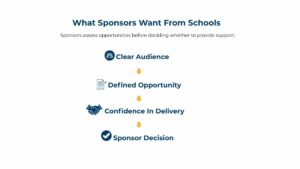
Figure 1. Sponsors commonly assess four key factors before deciding whether to support a school sponsorship opportunity: Clear Audience, Defined Opportunity, Confidence in Delivery, and Sponsor Decision.
Why Schools Get Ignored, Not Rejected
Most sponsorship requests that go nowhere aren’t rejected outright. They’re ignored. That’s an important distinction, because it points to the real problem.
Sponsors rarely say no because they’re unwilling to support a school. They disengage because the opportunity doesn’t give them enough to assess. A request that leads only with “we need funding for X” doesn’t tell a business who they’d be reaching, how the support would be recognised, or whether the relationship will be managed consistently. Without that information, the easiest response is no response at all.
Why This Matters For Schools
Understanding what sponsors want from schools helps schools present sponsorship opportunities more clearly and confidently.
Many schools already have what sponsors are looking for. Engaged parents, active alumni, strong P&C involvement, real local relationships. The problem usually isn’t a lack of community support.
The problem is that community support and sponsorship value aren’t automatically the same thing. A school can have an engaged, connected community and still struggle to attract sponsors, because that strength was never translated into something a business can evaluate.
Sponsors aren’t only responding to need. They’re assessing audience relevance, community engagement, and whether the opportunity aligns with their own objectives. Schools that can clearly communicate their reach and structure are simply easier to say yes to.
Schools may also benefit from understanding how to define and communicate their audience before approaching sponsors.
What Schools Commonly Get Wrong
The most common mistake is leading entirely with what the school needs: funding for a sports program, equipment, an event, a facility upgrade. These needs may be genuine, but they don’t answer the questions a sponsor is actually asking, including:
- Who does the school community reach?
- How engaged is that audience?
- What opportunities exist for acknowledgement?
- How will the sponsorship be managed and reported?
A second common mistake is assuming the community speaks for itself. Schools often know they have strong local relationships and high parent engagement, but don’t put that information in front of the sponsor. A third is treating each approach as a one-off request rather than part of a consistent, structured offer, which makes it harder for a business to assess the opportunity with confidence.
A Practical Framework For What Sponsors Are Assessing
1. Audience Relevance
Sponsors want to understand who the school community includes: parents, carers, alumni, local businesses and community organisations. This audience is one of a school’s most valuable sponsorship assets, but only once it’s defined.
2. Sponsorship Assets
What exists for acknowledgement and engagement? Newsletters, website recognition, events, school publications and community initiatives all count. Sponsors need to understand the opportunity, not just the funding request.
3. Management And Confidence
Sponsors want confidence that commitments will be delivered consistently. A structured approach to managing the relationship reduces uncertainty on their side.
4. Relevance And Alignment
Why would this specific opportunity matter to this sponsor? Local connection, shared community objectives and audience alignment all factor into a business’s decision, not visibility alone.
Example Wording And Scenario
A school approaches a local business seeking support for a STEM initiative.
Instead of:
“We are seeking sponsorship for our STEM program and would appreciate your support.”
Consider:
“Our school community includes more than 820 families and a highly engaged parent network. We’re exploring opportunities for local businesses to support our STEM program through a structured sponsorship arrangement that includes newsletter and website acknowledgement, and a clear report on outcomes at the end of the year.”
The second version doesn’t ask for more support. It simply gives the sponsor enough information to properly assess the opportunity.
What Schools Should Avoid
- Generic sponsorship letters that lead only with funding needs
- Assuming community support or local connection speaks for itself
- Creating a different sponsorship offer for every project
- Overpromising outcomes
- Language that suggests the school is endorsing the sponsor rather than acknowledging them
Frequently Asked Questions
Do sponsors still support schools?
Yes. Many businesses actively support schools when the opportunity is relevant and clearly structured.
If our school has strong community support, shouldn’t sponsorship be easy?
Not necessarily. Sponsors still need to understand how that community translates into a defined, assessable opportunity.
Do sponsors only care about exposure?
No. Audience relevance, community engagement and alignment with their own objectives usually matter as much as visibility.
Do schools need large audiences to attract sponsors?
No. Local relevance and genuine engagement are often more important than size.
What’s the most important thing sponsors are looking for?
Clarity. Sponsors need to understand the audience, the opportunity and how outcomes will be reported before they can commit.
Call To Action
Many schools already have real community reach and genuine local relationships. The problem is rarely a lack of community support. It’s communicating that value in a way sponsors can clearly assess.
Sponsorship Ready helps schools build structured, policy-aligned sponsorship programs that clearly communicate their value, build sponsor confidence and support long-term sponsorship outcomes.