
School Sponsorship Packages: Why Packages Often Fail

School Sponsorship Packages: Why Packages Often Fail

School Sponsorship Packages: Why Packages Often Fail

School sponsorship packages often fail due to lack of clarity and structure. Learn how businesses assess sponsorship opportunities and what schools miss.

School sponsorship packages are often seen as the foundation of a strong sponsorship approach.

Gold, silver and bronze tiers. Defined inclusions. Set pricing.

The challenge is not having packages.

The challenge is how those packages are structured.

That distinction matters.

The Real Issue Is Not Packages, It Is Clarity

Packages are designed to simplify sponsorship.

But in many cases, they introduce complexity.

From the school’s perspective, packages organize what is being offered.

From a business perspective, they can create confusion.

Sponsors are left asking:

  • What is the difference between each package?
  • Which option is actually relevant to us?
  • How does this connect to a specific outcome?

If these questions are not clear, packages do not simplify the decision.

They delay it.

Clarity removes uncertainty.

How Businesses Actually Assess School Sponsorship Packages

Businesses do not approach sponsorship as a comparison exercise.

They are not looking to choose between multiple tiers.

They are assessing whether one opportunity makes sense.

This means they are considering:

  • Is the opportunity clearly defined?
  • Does it align with our audience?
  • Is the value clear relative to involvement?
  • Can this be understood quickly?

When multiple packages are presented, the focus shifts from evaluating one opportunity to comparing several.

That distinction matters.

Where Schools and Clubs Go Wrong

The pattern is consistent.

Packages are used as a starting point instead of a structure.

Common issues include:

  • Tiered packages without clear differentiation
  • Similar inclusions across multiple levels
  • Pricing that is not linked to defined outcomes
  • Expecting the sponsor to choose the right option

Each of these increases the effort required to make a decision.

The business is left to interpret value.

Most will not.

What Structured Sponsorship Does Differently

Structured sponsorship removes unnecessary choice.

It focuses on presenting one clear opportunity.

This typically includes:

  • A defined initiative with a clear purpose
  • Specific audience and reach information
  • A simple explanation of sponsor involvement
  • A clear value aligned to a defined outcome

The difference is structure.

Instead of choosing between packages, the business assesses a single, well-defined opportunity.

Why This Distinction Matters

When packages are unclear, decision-making slows.

When structure is clear, decisions become easier.

That distinction matters.

Because businesses are not seeking options.

They are seeking clarity.

A More Practical Approach to School Sponsorship Packages

Improvement comes from simplifying the offer.

This means shifting from:

  • Multiple packages → One defined opportunity
  • Tiered options → Clear positioning
  • Assumed value → Explained outcomes
  • Sponsor-led choice → School-led clarity

Clarity removes uncertainty.

School sponsorship packages are often treated as a necessary structure.

In practice, they can create friction if not clearly defined.

The challenge is not whether packages exist.

It is whether the opportunity within them is structured clearly enough for a business to understand and act on.

Why Timing Is Not the Problem in School Sponsorship

Why Timing Is Not the Problem in School Sponsorship

School Sponsorship Timing: Why Timing Is Not the Problem

School sponsorship timing is often misunderstood. The issue is not when you ask, but how clearly the opportunity is structured and presented.

School sponsorship timing is often seen as the deciding factor in whether a business says yes or no.

End of financial year. Start of term. Budget availability.

The challenge is not timing.

The challenge is clarity.

That distinction matters.

The Real Issue Is Not When You Ask, It Is What You Present

Timing is often used to explain inconsistent sponsorship outcomes.

If a business does not engage, the assumption is that the timing was wrong.

But in many cases, the opportunity itself is not clearly defined.

From the school’s perspective, the timing felt appropriate.

From a business perspective, the opportunity may not have been clear enough to assess.

Sponsors are asking:

  • What is this opportunity?
  • Who does it reach?
  • How does this fit within our priorities?

If these points are unclear, timing becomes secondary.

Clarity removes uncertainty.

How Businesses Actually Think About School Sponsorship Timing

School sponsorship timing does play a role, but not at the beginning.

Businesses typically follow a sequence:

  • First, assess clarity and relevance
  • Then, consider timing and budget
  • Finally, decide whether to proceed

If the opportunity is unclear, the process does not move forward.

Timing is not considered because the opportunity has not been understood.

That distinction matters.

Where Schools and Clubs Go Wrong

The pattern is consistent.

School sponsorship timing is often overemphasized.

Common issues include:

  • Waiting for the “right time” instead of refining the opportunity
  • Re-sending the same proposal at different times
  • Assuming non-response is due to timing rather than clarity
  • Focusing on calendar cycles instead of structure

Each of these avoids the core issue.

The business is still left without a clear opportunity to evaluate.

What Structured Sponsorship Does Differently

Structured sponsorship focuses on clarity before timing.

It ensures the opportunity can be understood quickly.

This typically includes:

  • A clearly defined initiative
  • Specific audience and reach information
  • A simple explanation of sponsor involvement
  • A structured summary that is easy to review

The difference is structure.

Once clarity is established, school sponsorship timing becomes relevant.

Why This Distinction Matters

When school sponsorship timing is prioritised over clarity, results remain inconsistent.

When clarity is prioritised, timing supports the decision process.

That distinction matters.

Because businesses are not declining opportunities based on timing alone.

They are prioritising opportunities they can understand.

A More Practical Approach to School Sponsorship Timing

Improvement comes from reframing how timing is used.

This means shifting from:

  • Timing-first → Clarity-first
  • Calendar focus → Defined opportunities
  • Repetition → Refinement
  • Assumed readiness → Clear positioning

Clarity removes uncertainty.

School sponsorship timing is often treated as the main factor in securing outcomes.

In practice, it is secondary.

The challenge is not when schools are asking.

It is whether the opportunity is clear enough to be understood, assessed and acted on when it is received.

Why School Sponsorship Fails Without Structure (And What Businesses Actually Look For)

Why School Sponsorship Fails Without Structure (And What Businesses Actually Look For)

Why School Sponsorship Fails Without Structure

Many schools and clubs believe sponsorship is a visibility exercise.

Fence signage. Logo placement. Event mentions.

The assumption is simple.
If businesses can see the opportunity, they will support it.

The challenge is not visibility.

The challenge is structure.

The Real Issue: Lack of Commercial Clarity

Schools often have strong communities.

They have engaged families, active staff, and local relevance.

But this value is rarely presented in a structured way.

Instead, sponsorship is approached informally:

  • General requests for support
  • Broad ideas without definition
  • No clear commercial framing

That creates uncertainty.

And uncertainty slows decisions.

Clarity removes uncertainty.

How Businesses Actually Assess Sponsorship

Businesses are not assessing schools based on goodwill.

They are assessing alignment, reach, and return.

That distinction matters.

From a sponsor’s perspective, the key questions are practical:

  • Who is the audience, and how large is it?
  • What specific initiative is being supported?
  • How does this align with business objectives?
  • What is the visibility and duration?

If these are not clearly answered, the opportunity becomes difficult to justify internally.

Even if the intent is positive.

Where Schools and Clubs Go Wrong

The pattern is consistent across both schools and clubs.

The issue is not effort.

It is how that effort is structured.

Common gaps include:

  • No defined sponsorship packages
  • No clear valuation of initiatives
  • Limited articulation of audience reach
  • Conversations driven by ideas, not commercial logic

As a result, businesses are left to interpret the opportunity themselves.

Most will not.

What Structured Sponsorship Does Differently

Structured sponsorship changes how the opportunity is presented.

It removes ambiguity and replaces it with clear, commercial framing.

The difference is structure.

Instead of broad requests, schools present:

  • Defined initiatives with clear purpose
  • Estimated value ranges (e.g. $3,000 to $10,000)
  • Audience data including students, families, and staff
  • Specific outcomes and visibility points

This allows businesses to assess the opportunity quickly.

And with confidence.

Structure reduces friction.

Why This Matters

Businesses are not unwilling to support schools.

But they operate within commercial constraints.

Decisions require clarity, alignment, and justification.

When sponsorship is unstructured, it creates work for the sponsor.

When it is structured, it removes that work.

Clarity removes hesitation.

A More Practical Way Forward

For schools and clubs, the shift is not about doing more.

It is about presenting what already exists more effectively.

Most communities already have:

  • Strong reach
  • Meaningful initiatives
  • Local relevance

The opportunity is there.

But without structure, it remains difficult to translate into sponsorship outcomes.

Sponsorship does not fail because of lack of interest.

It fails when opportunities are not framed in a way businesses can assess.

That distinction matters.

When schools move from informal requests to structured presentation, the conversation changes.

The difference is structure.

Why School Sponsorship Assets Alone Don’t Secure Sponsors

Why School Sponsorship Assets Alone Don’t Secure Sponsors

Why Assets Alone Don’t Secure Sponsors

Most schools assume school sponsorship is about what they can offer.

Assets.

Logos. Signage. Mentions. Event exposure.

The challenge is not having assets.

The challenge is how those assets are positioned.

That distinction matters.

The Real Issue Is Not Assets, It Is Context

In school sponsorship, assets are rarely the limitation.

Schools often list what is available:

  • Fence signage
  • Newsletter mentions
  • Social media posts

From the school’s perspective, this demonstrates value.

From a business perspective, it lacks context.

Sponsors are not assessing items individually.

They are assessing how those items connect to an outcome.

Without that connection, school sponsorship assets feel disconnected.

Clarity removes uncertainty, and uncertainty prevents school sponsorship decisions.

How Businesses Actually Evaluate School Sponsorship Assets

Businesses do not buy assets.

They assess school sponsorship opportunities.

This means they are asking:

  • What does this asset actually deliver?
  • Who will see it, and how often?
  • How does this support brand visibility or positioning?
  • Is this part of a broader initiative or just placement?

If school sponsorship assets are presented without explanation, they are difficult to evaluate.

Even strong assets can be overlooked if they are not structured clearly within a school sponsorship opportunity.

Where Schools and Clubs Go Wrong With School Sponsorship

The issue in school sponsorship is rarely the assets themselves.

It is how they are presented.

Common patterns include:

  • Listing multiple inclusions without explaining their relevance
  • Treating all assets as equal without prioritization
  • Using general terms like “exposure” without detail
  • Separating assets from a defined initiative

Each of these increases ambiguity.

The business is left to interpret value.

Most will not.

This is where many school sponsorship conversations stall.

What Structured School Sponsorship Does Differently

Structured school sponsorship does not start with assets.

It starts with the initiative.

Assets are then aligned to that initiative.

This approach typically includes:

  • Defining a clear program, event or focus area
  • Connecting each asset to a specific outcome
  • Explaining audience reach in practical terms
  • Presenting assets as part of a cohesive package

The difference is structure.

Assets become more valuable when they are positioned within a clear school sponsorship framework.

Why This Distinction Matters in School Sponsorship

When school sponsorship assets are presented without structure, they compete for attention.

When they are structured, they reinforce a single opportunity.

That distinction matters.

Because businesses are not choosing between assets.

They are deciding whether the school sponsorship opportunity makes sense.

A More Practical Way to Present School Sponsorship

Improvement in school sponsorship comes from shifting how assets are framed.

This means moving from:

  • Lists of inclusions to defined opportunities
  • General exposure to explained visibility
  • Separate items to integrated packages
  • Assumed value to demonstrated relevance

Clarity removes uncertainty.

And removing uncertainty is what allows school sponsorship decisions to move forward.

School sponsorship is often approached as a collection of assets.

In practice, it is assessed as a structured opportunity.

The challenge is not whether schools have valuable assets.

It is whether those assets are presented in a way that businesses can understand, evaluate and act on with confidence.

Why Most School Sponsorship Proposals Get Ignored

Why Most School Sponsorship Proposals Get Ignored

Why Most School Sponsorship Proposals Get Ignored

School sponsorship proposals are often ignored due to lack of structure and clarity. Learn what sponsors actually look for and how to improve your approach.

Most schools assume that sending a sponsorship proposal is the final step.

A document is prepared, shared with businesses, and then followed up.

The expectation is that the proposal will speak for itself.

The reality is that many proposals are reviewed briefly, then set aside.

That distinction matters.

The Challenge Is Not Effort

The challenge is not the time spent creating the proposal.

The challenge is how the opportunity is presented.

Many proposals include broad descriptions of the school, its values, and its community. While relevant, they do not define a clear commercial opportunity.

Common inclusions are:

  • General school background
  • Lists of activities or programs
  • Statements about community engagement

What is often missing is structure.

Clarity removes uncertainty.

Without a clearly defined offer, sponsors are required to interpret value on their own. Most will not proceed.

How Sponsors Actually Assess Proposals

From a business perspective, a sponsorship proposal is not a document to read in detail.

It is a document to assess quickly.

Sponsors are looking for:

  • A specific initiative or opportunity
  • A clearly defined audience
  • A structured investment level
  • A direct connection to commercial or brand outcomes

If these elements are not immediately visible, the proposal loses momentum.

Businesses are not reviewing proposals for interest alone. They are assessing viability.

Where Schools and Clubs Go Wrong

In many cases, proposals are created without a commercial framework.

This leads to:

  • Multiple options with no clear positioning
  • Undefined pricing or inconsistent value levels
  • No explanation of outcomes linked to investment
  • A focus on what the school needs rather than what the sponsor gains

As a result, the proposal becomes descriptive rather than actionable.

The sponsor understands the school, but not the opportunity.

What Structured Sponsorship Does Differently

Structured sponsorship reframes the proposal from information to decision-making.

Instead of presenting general content, it focuses on defined opportunities.

For example:

  • One initiative, clearly outlined
  • Audience reach presented in practical terms
  • Investment aligned to a specific outcome
  • A clear next step for the sponsor

This reduces friction.

The difference is structure.

Why This Matters

Sponsors are not declining proposals because schools lack value.

They are declining because value is not presented clearly.

When a proposal removes ambiguity, it becomes easier to assess, compare, and approve.

Clarity removes uncertainty.

A More Practical Approach

Improving sponsorship proposals does not require more content.

It requires better structure.

This can include:

  • Reducing multiple options into focused opportunities
  • Linking investment levels to defined outcomes
  • Presenting audience and reach in simple terms
  • Making the next step clear and immediate

That distinction matters.

Most school sponsorship proposals are not rejected.

They are overlooked.

When structure is introduced, proposals shift from information to clarity.

And clarity is what allows decisions to be made.

Why School Sponsorship Conversations Stall After the First Meeting

Why School Sponsorship Conversations Stall After the First Meeting

Why School Sponsorship Conversations Stall After the First Meeting

Many school sponsorship conversations fail to progress beyond the first meeting. Learn what sponsors actually need and how structured sponsorship creates clarity and momentum.

Most schools assume that once a sponsor meeting is secured, progress will follow naturally.

The expectation is that interest leads to commitment.

The reality is different.

Many school sponsorship conversations stall after the first interaction. Not because businesses are uninterested, but because the next step is unclear.

That distinction matters.

The Challenge Is Not Interest

The challenge is not getting a meeting.

The challenge is what happens after.

In many cases, schools present broad ideas rather than defined opportunities. Conversations remain general:

  • “We are looking for support”
  • “We have a great community”
  • “We can promote your business”

While well-intentioned, this creates ambiguity.

Clarity removes uncertainty.

Without structure, sponsors are left to interpret value on their own. Most will not.

How Sponsors Actually Think

From a business perspective, the first meeting is an assessment point.

Sponsors are not deciding whether they like the school. They are evaluating:

  • Is there a clear opportunity?
  • Is the audience defined?
  • Is there a commercial outcome?
  • Is the next step obvious?

If these are not answered, momentum slows.

Businesses operate within structured decision-making. They expect the same in return.

Where Conversations Break Down

Schools and clubs often approach sponsorship conversations informally.

Common patterns include:

  • No defined sponsorship packages or initiatives
  • No clear pricing or investment levels
  • No follow-up structure after the meeting
  • No documentation to support the discussion

As a result, the conversation ends without direction.

The sponsor is left with interest, but no pathway.

What Structured Sponsorship Does Differently

Structured sponsorship introduces clarity at every stage of the conversation.

Instead of general discussion, it presents defined opportunities.

For example:

  •  A specific initiative with a clear purpose
  • A defined audience (students, families, community reach)
  • A set investment range aligned to outcomes
  • A clear next step following the meeting

This shifts the conversation from informal to commercial.

The difference is structure.

Why This Matters

Sponsors do not progress conversations based on enthusiasm.

They progress based on clarity.

When a school can clearly outline what is being offered, who it reaches, and what happens next, decision-making becomes easier.

That distinction matters.

A More Practical Approach

Schools do not need more meetings.

They need more structured conversations.

This includes:

  • Preparing defined sponsorship initiatives before engagement
  • Presenting information in a clear, commercial format
  • Setting expectations for follow-up
  • Reducing ambiguity at every stage

Clarity removes uncertainty.

Sponsorship conversations rarely fail at the introduction stage.

They stall when structure is missing.

When schools move from informal discussion to structured presentation, conversations do not just continue.

They progress.

Why Schools Struggle to Secure Sponsorship (And What Businesses Actually Look For)

Why Schools Struggle to Secure Sponsorship (And What Businesses Actually Look For)

Why Schools Struggle to Secure Sponsorship (And What Businesses Actually Look For)

Many schools struggle with sponsorship not because of lack of value, but lack of structure. Learn how businesses assess sponsorship opportunities and what schools need to change.

Most schools assume sponsorship is a matter of asking the right business at the right time.

The challenge is not effort.

The challenge is structure.

Schools often have strong community presence, engaged families and meaningful initiatives. Yet sponsorship outcomes remain inconsistent. That gap is not caused by lack of value. It is caused by how that value is presented.

That distinction matters.

The Real Issue Is Not Value, It Is Clarity

From a school perspective, the offer often feels clear.

From a business perspective, it rarely is.

Sponsors are not assessing intent. They are assessing clarity.

They are asking:

  • Who exactly is the audience?
  • How large and relevant is that audience?
  • What is the specific initiative?
  • What does association look like in practice?

When these points are unclear, the opportunity becomes difficult to evaluate.

Clarity removes uncertainty.

How Businesses Actually Think About Sponsorship

Businesses do not approach sponsorship as support.

They approach it as a commercial decision.

That means they are looking for:

  • Defined audience access
  • Alignment with their brand and positioning
  • Clear visibility or engagement outcomes
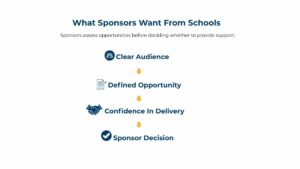
  • Confidence in delivery

If these elements are not structured, the decision becomes high risk.

Most businesses will not proceed in that situation. Not because they are not interested, but because the opportunity is not defined in a way that allows decision-making.

Where Schools and Clubs Go Wrong

Understanding School Sponsorship and Its Impact

The pattern is consistent across schools and clubs.

Sponsorship is often approached informally.

Common issues include:

  • Multiple disconnected ideas instead of one clear initiative
  • General audience descriptions instead of defined reach
  • Benefits listed without context or value
  • Conversations driven by relationships rather than structure

Each of these increases friction for the sponsor.

The more a business has to interpret, the less likely they are to proceed.

What Structured Sponsorship Does Differently

Structured sponsorship shifts the approach from informal to commercial.

It focuses on clarity, definition and alignment.

This typically includes:

  • A clearly defined initiative with a set value range
  • Specific audience data (students, families, staff, community reach)
  • A simple explanation of how a sponsor will be visible or involved
  • A consistent framework used across all conversations

The difference is structure.

Structure reduces ambiguity and allows businesses to assess the opportunity with confidence.

Why This Distinction Matters

Sponsorship outcomes are rarely limited by lack of interest from businesses.

They are limited by how easy it is to understand and evaluate the opportunity.

When a school presents sponsorship clearly, the conversation changes.

It moves from uncertainty to consideration.

Clarity removes uncertainty.

A More Practical Way to Approach Sponsorship

The shift is not complex, but it is deliberate.

It requires moving from:

  • Ideas → Defined initiatives
  • General reach → Specific audience data
  • Informal conversations → Structured presentation

That distinction matters.

Because when the structure is clear, the value becomes easier to recognize.

Sponsorship is often seen as a relationship-driven activity.

In practice, it is a clarity-driven decision.

The challenge is not whether schools have value to offer.

It is whether that value is structured in a way that businesses can understand and act on.

Why Most Schools Don’t Need More Sponsorship Ideas – They Need Structure

Why Most Schools Don’t Need More Sponsorship Ideas – They Need Structure

Many schools exploring sponsorship begin in the same place.

Ideas.

Sponsor boards. Fence signage. Event partnerships. Business breakfasts. Social media mentions.

The challenge is not creativity.

The challenge is structure.

In working with public schools across NSW and Queensland, one pattern consistently emerges. Schools often have valuable assets — engaged families, strong community footprint, meaningful initiatives — yet lack a commercially structured framework to present that value professionally.

Sponsorship does not fail because businesses are unwilling. It fails when schools approach it informally.

Local businesses are not seeking to donate. They are seeking alignment.

They want clarity around audience reach. They want a defined initiative. They want to understand how association with a school advances brand positioning, community presence and commercial objectives.

When a school can clearly articulate:

• Student population and family reach
• Staff footprint
• Community visibility
• Specific initiatives valued between $3,000 and $10,000

the conversation changes.

It becomes commercial.

Another misconception is that sponsorship requires significant time.

It does not.

It requires:

• Defined asset identification
• Structured packaging
• Defensible pricing
• Professional documentation
• Sequenced outreach

When those elements are in place, implementation can occur quickly. Recent mid-sized public schools have secured between $20,000 and $50,000 through structured activation within a defined timeframe.

The difference between sporadic sponsor wins and repeatable revenue is discipline.

Fundraising is event-driven.
Structured sponsorship is system-driven.

As schools plan for 2026, the relevant question is not whether sponsorship is possible.

It is whether the school is ready to implement it properly.

When structure is clear, revenue becomes measurable.

School Sponsorship Done Right: Finding Aligned, Long-Term Partners

School Sponsorship Done Right: Finding Aligned, Long-Term Partners

When schools begin looking for sponsorships, it’s easy to focus on “who has the most money.” Local developers, banks, national retailers — they seem like the obvious targets. But that mindset often leads to disappointment.

The most valuable sponsors are not always the biggest businesses — they’re the ones who align with your school’s values, care about your outcomes, and want to be part of your community story.

Here’s how to shift your thinking, identify the right-fit sponsors, and build relationships that deliver more than dollars.

Sponsors who stick around and invest meaningfully are the ones who care about what your school cares about. That means:

– Shared community footprint: They serve the same families, neighbourhoods, or interests your school does.
– Mission alignment: They care about education, equity, wellbeing, or leadership — not just exposure.
– Reputation matters: You’re building a long-term partnership. Choose sponsors your community will trust.

A local physiotherapist who supports junior sport might be a better long-term sponsor than a national fast-food chain that simply wants logo placement.

Instead of asking “who has money,” ask: “Who would benefit from being associated with this initiative?”

Here are a few real examples:

– Breakfast club → local grocer or café
– Mental health program → psychologist or allied health clinic
– Junior sport uniforms → physiotherapist or real estate agent
– STEM equipment → engineering or IT firm

By connecting the sponsor to a specific student-facing program, you’re creating a story they can support — and be proud to talk about.

Ask your staff and P&C: “Who in our community already supports us in quiet ways?” These people are often warm leads — local businesses owned by parents, former students, or community partners.

Many schools overlook great sponsors sitting right under their noses.

Also check your existing relationships: Do any current suppliers, partners or volunteers have business connections? A recommendation from someone inside your network goes a long way.

Some businesses can’t offer large financial contributions — but might provide:

– Catering for events
– Photography for school promotions
– Landscaping, printing, signage, equipment hire

These contributions can add significant value, reduce school costs, and strengthen ties — all without a cheque.

Recognise them by tier (e.g. Bronze or Community Partner), and link their contribution to the impact they supported.

Your initial approach matters. Avoid “we need money” language. Instead, lead with

– Your initiative
– The benefit to students
– Why you’re seeking community-aligned support
– What they’ll receive (within policy)

You’re not begging — you’re inviting someone to invest in something meaningful.

Before accepting support, ask:

– Do they align with our school values and policies?
– Are they a trusted and ethical operator in the community?
– Would parents, staff, and students be proud to see this name on an initiative?

Your school’s reputation matters. A well-aligned, smaller sponsor is always better than a flashy one that doesn’t reflect your values.

Sponsorship isn’t about “who can give the most” — it’s about who makes the most sense. The best sponsors are those who

– Align with your values
– Care about your community
– Fit naturally with the initiatives they support
– See your students’ success as part of their own story

By shifting your focus from dollars to alignment, you’ll build longer-lasting, more valuable partnerships — the kind that grow over time, advocate for your school, and contribute more than just cash.

School Sponsorship Made Simple: Moving Beyond Fundraising

School Sponsorship Made Simple: Moving Beyond Fundraising

Most schools are familiar with fundraising. From sausage sizzles to raffles and read-a-thons, traditional fundraising has long been part of the educational landscape. But sponsorship is a different ballgame — and to succeed, schools must move beyond old mindsets and embrace a new strategic approach.

Fundraising is typically transactional. It’s about the school asking the community to give money in return for goodwill, prizes, or participation. It’s focused inward, often dependent on volunteers, and usually tied to short-term goals.

Sponsorship, on the other hand, is a strategic partnership. It’s about aligning your school’s values and community reach with a business’s objectives. A sponsor doesn’t “donate” — they invest in a relationship that brings visibility, credibility, and impact.

This difference matters. Schools that confuse the two often underprice their offerings, pitch in the wrong way, or struggle to secure meaningful support. Making the mental shift is the first step to changing outcomes.

Principals and school leadership teams set the tone. When leadership sees sponsorship as an aligned, purposeful strategy — not just “raising money” — it unlocks resources, staff buy-in and internal confidence.

That mindset shift includes:

– Valuing the school brand — recognising that your school’s story, reach and outcomes are assets.
– Understanding business thinking — appreciating that sponsors have objectives, KPIs and budgets.
– Treating sponsorship as strategy — embedding it in your school’s improvement plan, not treating it as a side hustle.

Leaders who understand and communicate this distinction enable their teams to pursue sponsorship opportunities with clarity, confidence and purpose.

Unlike fundraising, which often appeals to charity or obligation, sponsorship is about mutual benefit.

Schools bring:

– Community access and trust
– A clear mission (education, equity, wellbeing, leadership)
– Initiatives that make measurable impact

Sponsors bring:

– Financial support
– Brand visibility and credibility
– In-kind support or professional expertise

When positioned well, it’s a win-win. But schools must be able to articulate their audience, impact, and how sponsorship connects to student outcomes — not just visibility.

Let’s look at two ways to pitch the same request:

Fundraising mindset:
“Would your business consider donating $500 to help our under-14s netball team buy uniforms?”

Sponsorship mindset:
“We’re looking for a local partner to support our junior sport program. Your brand would be acknowledged on our uniforms and digital newsletter, with a link to the student wellbeing initiative the team promotes.”

Same ask — different frame. The second approach positions the school as a professional partner, and the sponsor as someone contributing to a meaningful initiative.

Making the mental shift also means refreshing your tools. Many schools are still using outdated fundraising letters or sponsorship documents that don’t speak the language of business.

You need:

– A concise, visual sponsorship invitation (not a cluttered flyer)
– A benefits matrix tied to outcomes, not just logo placement
– Clarity around school policy, brand tone and communication boundaries
– A follow-up plan and a sponsorship calendar (ideally term-based)

These tools don’t just look better — they reinforce the professional, strategic identity you want sponsors to associate with your school.

The schools we’ve seen make the biggest strides are those that start by shifting internal attitudes. That includes:

– Running a short PD session on what sponsorship is and how it works
– Ensuring all staff know who your sponsors are and how to acknowledge them
– Embedding sponsorship literacy in your school communication guidelines
– Celebrating sponsor-supported outcomes (not the sponsors themselves) in school newsletters, assemblies, and community events

When staff and community understand that sponsorship is about enabling student success, not selling out, the culture begins to shift. Enthusiasm grows. Conversations become easier. And sponsorship becomes something your school does confidently and proudly — not awkwardly or quietly.

Sponsorship is not fundraising in a suit. It’s a fundamentally different approach — one that asks your school to recognise its community value, align with business goals, and build long-term partnerships that support students.

If your team still sees sponsorship as just another way to get cash, it’s time to reset. With the right mindset, tools, and strategy, sponsorship can become one of your school’s most powerful and sustainable income streams.